 ccowannarratives@gmail.com

The Most Surprising Gains That Come from Loss
We are culturally programmed to see loss as a simple equation of subtraction. This is the biggest reason why, when we lose a career path, a physical capability, or a long-held dream, we naturally focus on the void. But psychology and neuroscience suggest a more complex reality.
There is a phenomenon which we call the ‘Gift of Absence’. It means there are times when losing something creates a space that eventually fills up with better abilities, like:
- Sharper senses that catch details easily missed
- Deeper emotions that let you truly connect
- A new perspective that changes everything
Though this is not a consolation prize. It is just fundamental rewiring of the human experience. Hence, when the noise of our previous life is no longer there, we often find that we have gained things we didn’t even know were missing. Let’s get into the details!
Loss Always Opens Doors to Surprising Gains
While most of us are familiar with Post-Traumatic Stress, fewer people discuss its counterpart: Post-Traumatic Growth (PTG). It was coined by psychologists Richard Tedeschi and Lawrence Calhoun in the mid-1990s. This concept refers to the positive psychological changes that result from struggling with highly challenging life circumstances.
So yeah, do not mistake it with staying positive. It is rather related to the basic change in how a person perceives their existence. There is plenty of research that indicates that survivors of life-altering events often report three specific areas of growth. Have a look:
- Greater appreciation for life, which means they notice the small things previously ignored.
- Enhanced relationships because they shift towards quality over quantity in social bonds.
- Recognition and increase of resilience, especially the one never been put to a test before.
How Loss Can Lead to a Surplus of Empathy
One of the most profound gains of a physical or situational setback is the development of Somatic Empathy. Have you heard of this before? No? Here is what this means.
It is when your body almost mirrors what someone else is feeling.
Instead of just understanding their pain in your head, you sense it physically.
For instance, your chest tightens when you are anxious, or your shoulders feel tense when someone else is upset. This quality is not inherited; it forms its roots in the mind of a person who has been through setbacks. Scientists say this happens because these people have learned to listen more closely to their own bodies.
But Where Does It All Begin?
When you are forced to move through your life and the world differently, your brain becomes hyperattuned to others’ struggles and subtle cues. This means you begin to prioritize non-verbal data that most people overlook.
Moreover, when you can no longer rely on your old routines or abilities, you naturally start scanning your environment for safety and connection.
You begin to notice the micro-expressions on a friend’s face, the slight tremor in a stranger’s hand, or the heavy energy in a room. This heightened awareness transforms into a deep social intelligence, allowing you to connect with others on a level that words alone cannot reach.
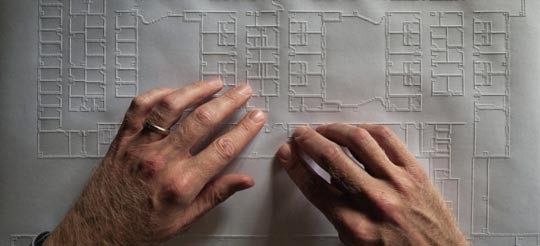
A real-world example of this phenomenon is Chris Downey.
He is a man with 30 years of practice in architect and has been working without sight since 2008. He lost the ability to see unexpectedly one day, but instead of ending his career, he discovered a surprising gain. He began to hear and feel architecture in a way sighted architects couldn’t. He gained a deeper understanding of how space affects the human nervous system.

You Also Experience a Sensory Reset
Losing an ability, especially one as central as speech or mobility, changes our relationship with nature in a way you least expect. Oh no, this is not us bragging. This fact is backed by the Biophilia Hypothesis. It is a theory that says we as humans are built to love nature.
It is not just a preference. It is in our DNA. That is why a walk in the park feels calming, and sitting by the ocean clears our head. Thus, being around living things like trees, animals, and even plants, reminds us where we came from and helps us feel whole again.
So, when someone living in silence or under any physical restriction focuses on nature, it becomes a non-judgmental space for that person. Unlike human society, which often demands output and explanation, a forest or a shoreline requires nothing.
➡️ Nature’s Way of Sharpening the Mind
The Gain of Presence
For starters, see what the studies from Stanford University show. They prove that spending time in nature specifically lowers activity in the part of the brain associated with rumination. It is the loop of negative thoughts about the past.
Contemplative Observation
Secondly, in the absence of one’s own voice, the volume of the natural world becomes comparatively high. This is the reason you notice the networks of trees or the specific shift in light at dusk. This isn’t just a hobby you pick after falling sick; it is a sensory expansion.
When You Can’t Do Things Anymore, Start Being!
Yes, you got that right. Stop doing and start being. In a high-pressure environment, you are forced to think that your value is tied to your productivity. You were fed the narrative that you are what you do. Drop that immediately. It was a lie.
While this sudden revelation could feel like a catastrophe at first, it eventually leads to the most surprising gain of all – the Internal Validation. Think of a situation where you are no longer able to perform your tasks at the previous level. You start observing yourself in the quiet.
- Was my worth only tied to my vocal cords?
- Am I nothing more than my job title at work?
- Would people still value me if I slowed down?
This realization provides a level of freedom that most people spend their whole lives trying to find. It is the gain of a core self that is independent of external achievements.
What is Your Hidden Gift?
If you are currently facing a setback, the gain likely isn’t visible yet. But that does NOT mean it is not there. It is rather often buried under the weight of the loss and needs some digging. So, the challenge is to look for the silver lining not as a cliché metaphor, but as a biological reality.
- Find your new skill and ask yourself if your setback made you a better listener? Observer?
- Reconnect with the other senses of yours that are still underexplored.
- Frame your achievement from a new outlook. Such as check if you weren’t productive today, who were you instead? Were you attentive? Were you present?
Conclusion
Loss is surely a silent room that is ever ready to consume you, but it is ever an empty one. So, try stepping into that quiet room and find what you have to trade your losses with.
If you ask us, the most surprising gain is the realization that while you may have lost a piece of your history, you are about to gain a deeper connection to the present. Last but not least, there are plenty of inspiring real-life examples in the world. Give them a read, and you will find the way!